What are Elo ratings?
Elo ratings are named for Arpad Elo, a physics professor born in 1903. Elo ratings are most famous from their use in chess. Players are assigned a starting rating. This number is adjusted up or down as players win and lose matches.
In our fantasy league, each team is assigned a starting value of 1,500 points. The amount of points a team gains or loses depends on the quality of its opponent. If teams have the same rating, they will each gain or lose an average number of points (around 10). If one team is significantly better than another, it will gain fewer points for a win (perhaps 4). The loser will fall by the same number of points. This change reflects the difference in quality – the superior team gets less credit for defeating inferior competition. The weaker team is penalized less for losing to a better opponent.
The opposite happens in the case of an upset. If a much lower rated team wins, it will gain more points (15+) while the better team loses more points (-15). This unexpected result gives important new information about the quality of each team, so it accounts for a higher total number of points for defying expectations. If there is a tie, no points are awarded or subtracted.
Eventually, teams reach relatively stable ratings that represent their true talent levels. The key benefit of Elo ratings is that they incorporate opponent quality into the mathematics of rankings. Instead of assigning simple plus and minus point totals, the ratings evolve to reflect the level of competition.
What do different ratings mean in practical terms?
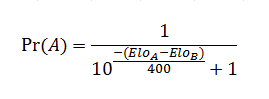
The difference in the ratings of two teams serves as a predictor of who will win a match. For example, if a team is rated 100 points higher than its opponent, it is expected to win 64% of the time. If the rating is 200 points higher, the team has a 76% chance of winning. The formula for calculating expected winning percentage is:
How did Elo ratings look for 2015?
There are two ways to look at Elo ratings. The first is to look at single-season ratings. These assume that each team begins a season at the same level.
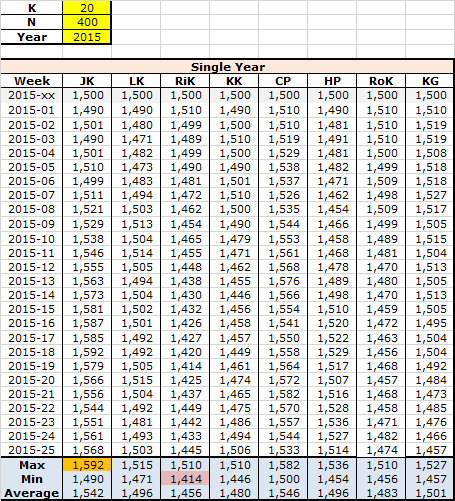
Each team begins the season with a rating of 1,500. K and N are mathematical parameters that govern the elasticity of ratings. The ratings evolve as time progresses. In the first week, each team’s rating goes or down by 10 points. Compare this to the end of the season. Kyle’s rating increased by 12 points in week 25, while Heather dropped by 13 in another match. Jeff gained only 7 points for a win. These gains and losses reflect the quality of each team’s opponent.
There are several highlights shown in this table:
- The Lannisters achieved the highest rating for the season in week 18 after defeating the Kazoos.
- Rick suffered the lowest rating at 1,414 in week 19 after losing to the Legion.
- The Thunderwolves, Armadillos, and PhoeGnomes were all clustered around 1,500. This makes sense as they were a combined 34-34-7 (or, roughly, average).
- The Legion peaked in week 21 after defeating the Lannisters, but still finished well above average.
This chart shows how the single-year ratings evolved over time for each team:
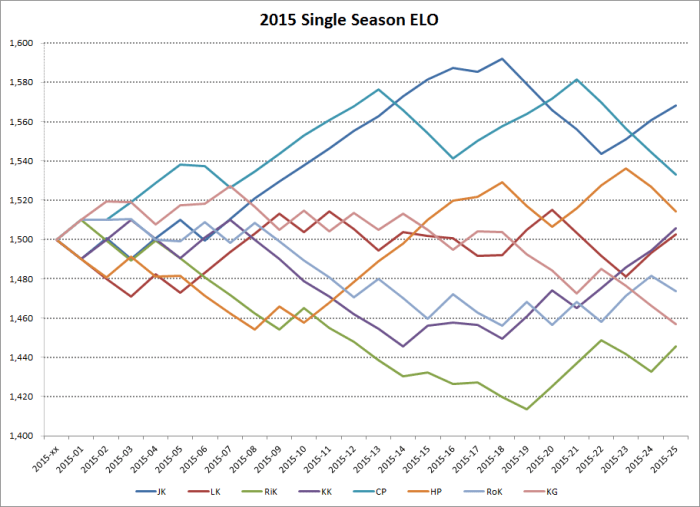
- After a slow start, the PhoeGnomes and Thunderwolves were able to build momentum to end the season.
- The Goofballs were firmly in the middle of the pack before fading to close the year.
- The Legion and Lannisters each suffered losing streaks, but the Lannisters were able to rally to end the year.
- The Possums bottomed out in mid-August before winning several matches near the end
- The Armadillos were the most consistent team, hovering near 1,500 for most of the season.
All-Time Elo Ratings
In leagues that re-draft every year, single-season ratings make sense. However, our league features several freezes, teams retain their talent across seasons. The second way to look at Elo ratings is to carry them over from one year to the next. The math stays the same:
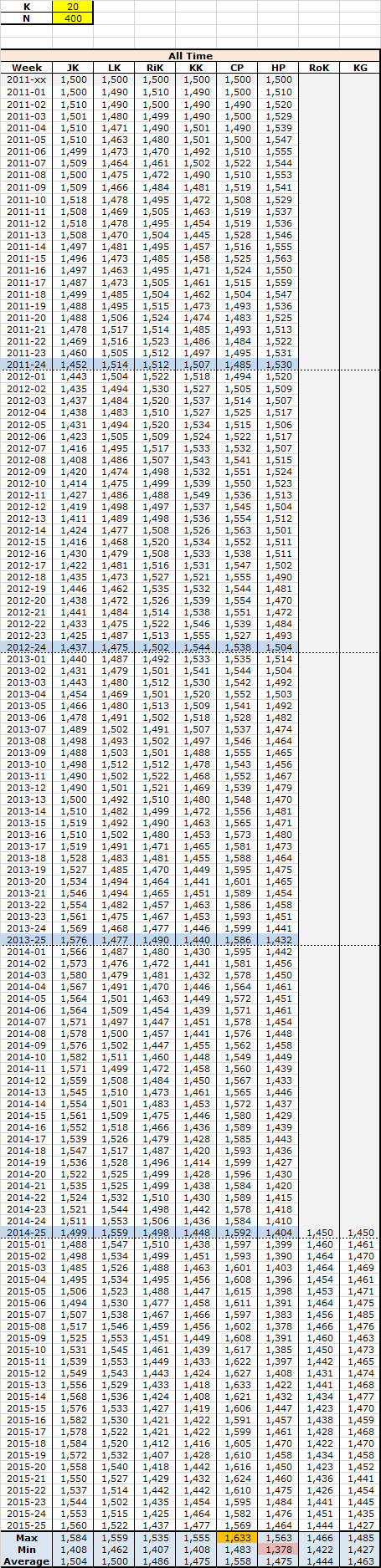
Several points stand out from this table:
- The Legion achieved the highest rating in league history in Week 13 this year. A victory over the Goofballs capped a long winning streak. Since information is transferred from year to year, the relative strength of Chris’s victories gave him a record-high peak value.
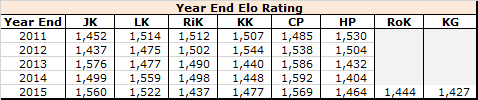
- The lowest rating (1,378) belongs to the PhoeGnomes, who reached bottom in Week 8 of 2015. Heather entered the year with a low rating (1,404) and suffered a series of defeats that pushed her number even farther down. However, she rallied through the end of the season to attain a final rating of 1,464. This was ahead of the Possums, Goofballs, and Kazoos.
- Rather than enter the year with an average rating of 1,500, the Goofballs and Kazoos received 50-point handicaps to better reflect their talent level after their first draft. Both teams started off well, but eventually faded somewhat, finishing with 1,444 and 1,427 ratings respectively.
- The Lannisters, PhoeGnomes, and Thunderwolves improved on their year-end 2014 season ratings.
- The largest single-season ratings jump came from the Lannisters from 2012 to 2013. They gained 139 points en-route to the league title. The Thunderwolves lost 105 points over that span.
- The Armadillos had an 82 point jump from 2013-2014. They also won the title.
- 2015 was the first year the Legion lost ratings points over a previous season. Despite losing close races for the title, the Legion gained 107 points over three seasons. This is more impressive considering the Legion were the Elo rating leaders during this time, and received few points for victories and greater penalties for losses.
- 2015 was the first year the PhoeGnomes gained ratings points from the previous season. After winning the 2011 title, Heather lost ground in each successive season before rebounding at the end of 2015.
- The Goofballs and [former] Kazoos have the best opportunity to make up ground. Their low ratings to end 2015 will give them larger boosts for wins in 2016.
The multi-year chart shows the fluctuations in Elo ratings over time:

- Since Week 9 in 2012, only the Thunderwolves and Lannisters have achieved an Elo rating higher than the Legion. The Lannisters held the lead for four weeks in 2014. The Thunderwolves overtook the Legion for two weeks in late 2012.
- After overtaking the Thunderwolves in Week 9, 2012, the Legion have lead the league in Elo for 91 out of 97 weeks (94%) and for 39 consecutive weeks entering 2016.
- The Legion lead the Lannisters by just 9 rating points going into 2016. At the end of 2014, the Legion led the Lannisters by 93 points and the Armadillos by 33 points.
- The PhoeGnomes were able to reverse a severe multi-year downward trend at the end of 2015. Heather’s first-year dominance is notable in 2011.
- Since a ratings explosion in the 2013 season, only the Armadillos, Legion, and Possums have achieved a higher rating than the Lannisters.
More Information
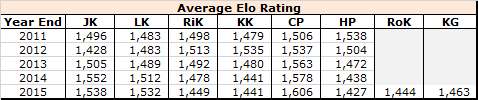
The following charts show more Elo information, including year-end and average ratings. Team highs and lows are also shown.

Future of Elo Ratings
In future League Updates, I will post updated in-season and all-time Elo ratings. I will also post the win probabilities for upcoming match-ups derived from each rating set.
 Dirt Mountain Baseball League